Lovable
AI-powered no-code platform for building apps, websites, and digital products quickly without deep coding skills required.
Key Features
- ✓AI-powered app and website building
- ✓No-code development platform
- ✓Fast digital product creation
- ✓Visual development interface
- ✓Automated code generation
What Is Lovable?
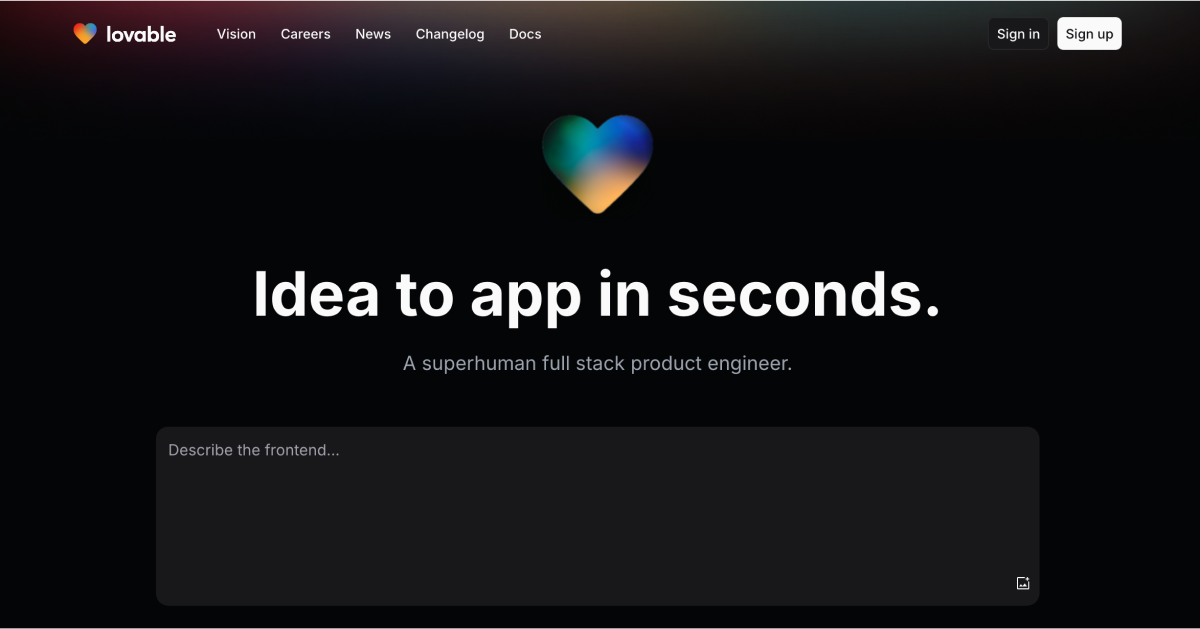
Lovable.dev calls itself the world's first "AI Fullstack Engineer." The pitch is straightforward: you describe what you want in plain English, and it writes the code for you. And it is not just a simple landing page builder -- it generates a modern tech stack with React and Tailwind CSS on the frontend and connects to backend services like Supabase.
The tool grew out of the GPT-Engineer project and has become one of the more polished entrants in the "vibe coding" wave of AI app builders. You get a Supabase backend with hosting, authentication, and storage out of the box. You can edit your app visually, chat with the AI for fixes, or edit the code directly if you want more control.
Who Is It For?
It seems built for a few specific types of people: founders without a tech background who need to get an MVP up and running without spending a fortune on developers; product managers and designers who want to build functional prototypes that feel real; and seasoned developers who want to let an AI handle boring setup and boilerplate so they can jump straight into the more interesting parts of a project.
For cross-functional teams -- where product managers, marketers, and designers collaborate with developers -- Lovable acts as a bridge. That said, it skews heavily toward the non-technical end of the spectrum. If you are a senior engineer looking for an AI pair programmer inside your existing IDE, Cursor fits that mold better. Lovable and Bolt are accessible to users without a coding background, while Cursor is better suited for those with programming experience and a development environment.
How It Works in Practice
The core loop is prompt-in, app-out. Once you enter a prompt, Lovable's AI builder generates the app's user interface along with the backend, complete with the necessary database.
In default mode, you type what you want, and Lovable creates pages, logic, and components. There is also a chat mode that won't write code for you but helps you think through a problem or explain a chunk of code.
The platform is surprisingly good at generating clean, nice-looking user interfaces and components. Instead of grinding through hours of boilerplate code for buttons, forms, and page layouts, a developer can just ask Lovable to create them. It also has a visual editor that feels a bit like Figma for making smaller tweaks without burning through prompts.
GitHub sync is baked in, so you can export the generated code and take it anywhere. Some developers use that as a deliberate escape hatch: they quickly generate the frontend with Lovable, then export components and rebuild the core app on a preferred stack like Next.js or custom React setups.
Pricing
Lovable runs on a credit-based model. The platform has Free, Pro ($25/month), Business ($50/month), and Enterprise (custom) plans.
| Plan | Monthly Price | Credits | Notes |
|---|---|---|---|
| Free | $0 | 5/day | Public projects, limited features |
| Pro | $25 | 100/mo | Private projects, custom domains |
| Business | $50 | More credits | Team collaboration, advanced features |
| Enterprise | Custom | Custom | Dedicated support, custom needs |
Annual billing saves money, and unused monthly credits roll over as long as your paid subscription stays active.
University students get 50% off the Pro plan after verification.
The catch is that every AI action consumes credits at a different rate depending on complexity, so in practice you may spend more as your app takes shape. Complex refactors or debugging sessions can drain credits faster than you expect.
Where It Falls Short
The main limitations are inconsistent results across prompts and the credit-based pricing, which makes it difficult to forecast costs. It can also get stuck in a debugging loop that you have to correct manually.
Lovable is positioned somewhere between no-code simplicity and developer control. That positioning works great for prototypes, but it struggles at the production end. While Lovable is great for prototyping, it hits serious limits when you attempt to use it for complex, production-grade applications. It lacks the robustness required for scalable, secure, and maintainable backends.
There is also a security concern worth flagging. A critical security vulnerability was identified by Guardio Labs in an April 2025 report, dubbed "VibeScamming," finding Lovable AI to be highly susceptible to misuse for generating convincing phishing websites, including pixel-perfect clones of legitimate login pages. Lovable has reportedly been working to address this, but it is something to keep in mind if you are thinking about the platform's guardrails.
The Bottom Line
Lovable is a fast, AI-first builder for getting a working web app scaffold off the ground quickly, but teams aiming for production-grade security and complex integrations should plan for manual hardening. For spinning up an MVP to test with real users, or for generating a frontend scaffold that your dev team then takes over, it genuinely saves time. Beyond that, the credit costs and architectural limits become friction fast. Go in with clear expectations about where the tool stops and your engineering work begins.