Visual Studio Code
Free, open-source AI-powered code editor with GitHub Copilot integration for building and debugging modern web and cloud applications.
Key Features
- ✓GitHub Copilot AI integration with chat and agent modes
- ✓Multi-model AI support (GPT, Claude, Gemini and more)
- ✓Local and remote codebase indexing for context-aware AI
- ✓Cloud agent for async PR creation and code refactoring
- ✓Custom agents, instructions, and reusable prompt files
- ✓Cross-platform support (Linux, macOS, Windows)
- ✓Extensive extension marketplace
- ✓Integrated terminal and debugger
Visual Studio Code
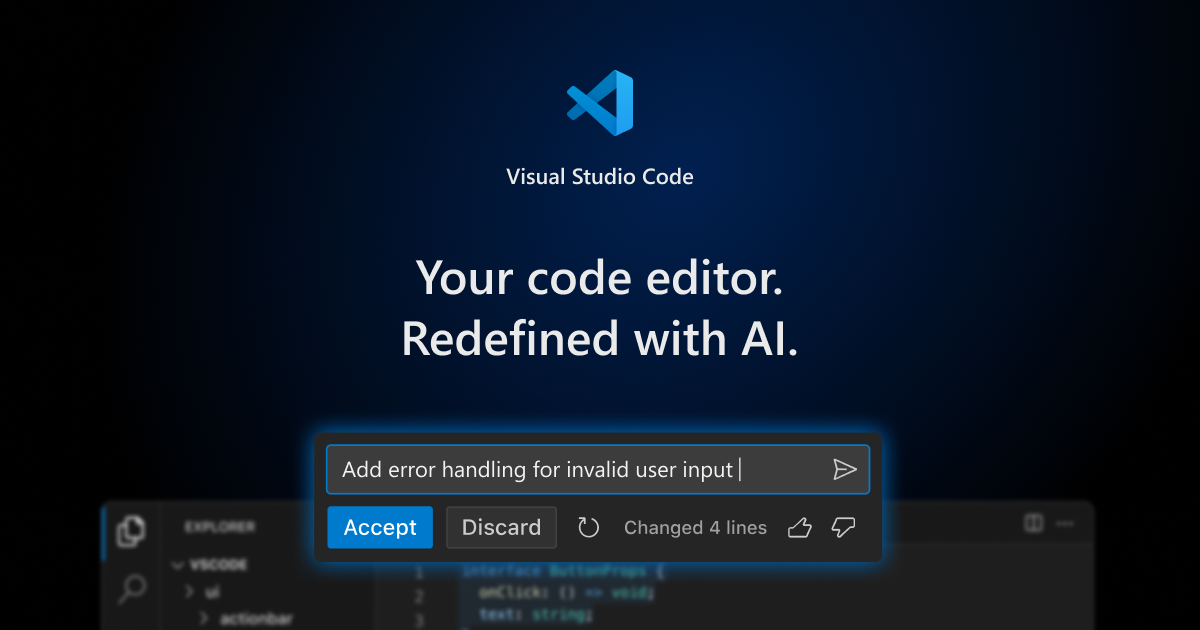
Visual Studio Code has been the default code editor for most developers for years now. Built on Electron by Microsoft and released as free, open-source software, it sits in the space between a lightweight text editor and a full IDE. You get syntax highlighting, IntelliSense, an integrated terminal, a debugger, Git support, and access to thousands of extensions, all without paying anything. In 2024 and 2025, it has pushed further into AI-assisted development, making GitHub Copilot a first-class citizen rather than a bolt-on plugin.
What It Does
VS Code is a general-purpose code editor with IDE-like features. It handles everything from editing a quick shell script to working on a large multi-service application. The integrated debugger covers most major runtimes, and the terminal keeps you inside one window for the majority of your workflow. The extension marketplace fills in whatever is missing by default, from language servers to Docker tooling to database clients.
GitHub Copilot agent mode, introduced in early 2025, acts as an autonomous peer programmer. It performs multi-step coding tasks at your command, analyzing your codebase, reading relevant files, proposing file edits, and running terminal commands and tests.
It responds to compile and lint errors, monitors terminal and test output, and auto-corrects in a loop until the task is completed. This is a meaningful step up from simple autocomplete, and it runs directly inside the editor without any separate toolchain.
Who It Is For
VS Code targets working developers across the full stack. Frontend developers, backend engineers, DevOps practitioners, and data scientists all use it, which is partly why the extension ecosystem grew so large. It works equally well on Linux, macOS, and Windows, which matters on teams with mixed operating systems. If you are coming from a heavier IDE like IntelliJ or Visual Studio, some things will feel less polished by default, but extensions usually close that gap.
Pricing
VS Code itself is free with no commercial restrictions. The AI layer is where tiered pricing comes in.
GitHub Copilot now comes in a free tier, joining other plans called Pro, Business, and Enterprise.
| Plan | Cost | Completions | Chat |
|---|---|---|---|
| Copilot Free | $0 | ||
| 2,000/month | |||
| Limited | |||
| Copilot Pro | |||
| $10/month or $100/year | |||
| Unlimited | Unlimited | ||
| Copilot Business | Per seat (org) | Unlimited | Unlimited |
| Copilot Enterprise | Per seat (org) | Unlimited | Unlimited + org context |
GitHub Copilot Free is available for individual developers, but users assigned a Copilot Business or Copilot Enterprise seat are not eligible for access to the free tier. The free tier is a reasonable starting point for solo work or evaluation.
Strengths
The extension marketplace is the real moat. Whatever language, framework, or workflow you use, there is almost certainly an extension for it, and many are maintained by the vendors themselves. The editor is also genuinely cross-platform in a way that matters day to day, not just "it compiles on all three." Remote development over SSH and in containers is solid, which makes it practical for working on cloud servers without leaving your local setup.
The AI integration in 2025 is now deep enough to be useful rather than gimmicky. Copilot agent mode can create apps from scratch, perform refactorings across multiple files, write and run tests, and migrate legacy code to modern frameworks. That covers a meaningful chunk of repetitive work.
Limitations
The Electron foundation is the most common complaint. VS Code uses a great amount of RAM and CPU.
Compared to alternatives like Zed, which runs on Rust and uses around 600MB of RAM, VS Code and similar editors can demand 3 to 4GB. If you are running local AI models, dev servers, and Docker simultaneously, that overhead adds up. There are also periodic reports of RAM usage increasing significantly and VS Code becoming noticeably slow even with no extensions enabled after updates.
The extension model is both a strength and a source of friction. A heavy extension setup can make startup noticeably sluggish, and extension quality varies widely. For developers who want something that just works without curation, the out-of-box experience is thinner than a dedicated IDE.
The Bottom Line
VS Code earns its dominant position. It is free, actively developed, and genuinely useful across a wide range of development contexts. The GitHub Copilot integration is now one of the more capable AI coding setups available, especially with agent mode landing in stable builds. The main trade-off is resource consumption, and if that matters to you, alternatives like Zed or Neovim are worth evaluating. For everyone else, VS Code is a solid default that rarely gets in the way.