Cursor Ships Controlled Dev Environments for Cloud Agents
Cursor's new release gives teams full control over the environments their cloud agents run in — with multi-repo support, Dockerfile-based config, 70% faster builds, and environment-level audit logs.
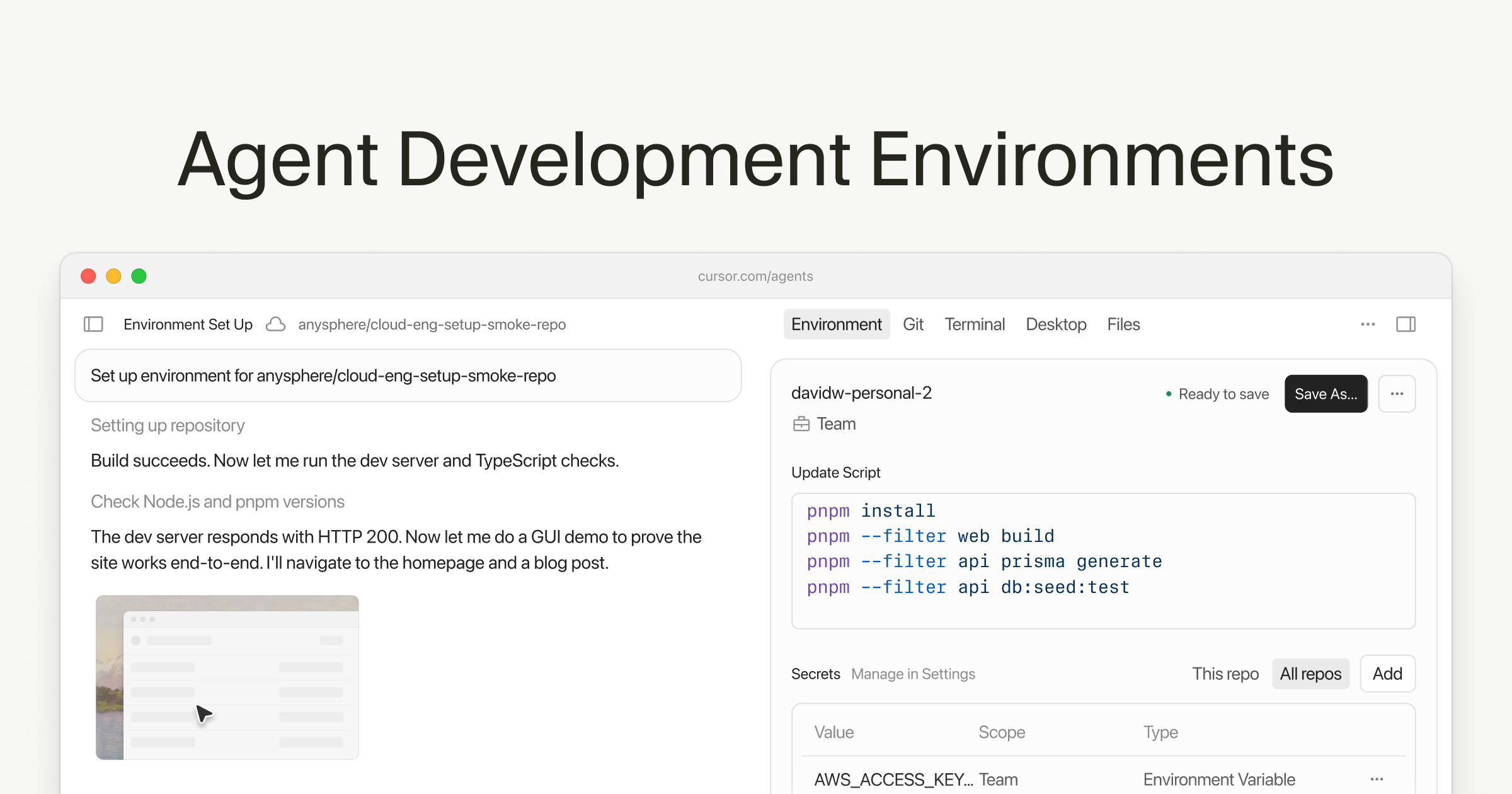
Image by Cursor
Cursor Ships Controlled Dev Environments for Cloud Agents
Cursor shipped a significant update to its cloud agent platform on May 13, giving engineering teams granular control over the environments their agents run in — a prerequisite for using cloud agents reliably on real production tasks.
The release addresses a core limitation of cloud-based coding agents: without a proper development environment matching your team's actual stack, agents can write code but cannot run tests, reach internal APIs, or verify their work. That loop-closing capability is what separates agent demos from agents that actually ship.
"Cloud agents are easier to parallelize than local agents, continue working when your laptop is closed, and can operate autonomously in response to programmatic triggers," Cursor noted in its blog post. "But agents are only as capable as the environments they run in."
Multi-Repo Environments
The most impactful change for enterprise teams is multi-repo support. Cloud agents can now be configured with multiple repositories in a single environment, letting a single agent reason across an entire microservices architecture — not just the repo it happened to start in.
Environments persist across sessions, so agents do not start from scratch each time. Steven Cheng, Senior Engineering Manager at Amplitude, described the practical impact: "Multi-repo support is what makes them actually useful. An agent can investigate a reported issue, figure out which repos it touches, and open a PR with the fix in the right places with full context."
Dockerfile-Based Config and 70% Faster Builds
Cursor has overhauled its Dockerfile-based environment configuration with two meaningful upgrades. First, build secrets are now supported, allowing private package registry access during image builds without leaking credentials into the running agent's environment — secrets are scoped to the build step only and are not passed forward.
Second, layer caching has been upgraded so that only layers that changed since the last build are rebuilt. Cursor says builds that hit the cache now run 70% faster, cutting the feedback loop for teams iterating on environment configs from minutes to seconds.
For teams that do not want to write Dockerfiles from scratch, Cursor can inspect repos, identify the tools and dependencies required, and produce a configuration to edit and version. That feature is in private beta and will roll out to Enterprise teams over the coming weeks.
Agent-Led Environment Setup
As Cursor configures a development environment, it now actively validates the configuration: asking questions, flagging missing credentials, and confirming the environment is ready before handing off to an agent. If environment setup fails at any point, Cursor falls back to a base image with clear warning indicators so that cloud agents can keep running rather than immediately failing or silently producing bad results.
Cursor will also always show the version of the environment the agent is currently running in, giving developers visibility into exactly what configuration is in effect.
Environment Governance and Security Controls
Every development environment now has a full version history. Users can review past states and roll back; admins can optionally restrict rollback permissions to admin-only. An audit log records every action team members take on environments, giving security teams a complete record of who changed what and when.
Egress and secrets are now scoped at the environment level. A team can restrict outbound network access to a specific allowlist for one environment while leaving another more permissive. Secrets configured for one environment are not accessible from any other — eliminating a common source of cross-environment credential leakage.
What This Means for Developer Teams
This release is a direct response to the reality that cloud agent adoption in enterprise settings has been slowed by environment management overhead. Teams running multi-service architectures need agents that understand the full system, not just a single repo. The governance controls — version history, audit logs, scoped egress — are the table stakes that security and platform teams require before approving broad agent usage.
Cursor says the next phase is environments that evolve autonomously as codebases change, removing the manual rebuild step entirely.
To get started, teams can read the docs or visit the cloud agents dashboard.