OpenAI Merges ChatGPT, Codex, and API Into One Agentic Platform
OpenAI is collapsing ChatGPT, Codex, and its developer API into a single product team under Greg Brockman, with Codex chief Thibault Sottiaux leading a unified super app ahead of a potential IPO.
TechTimes
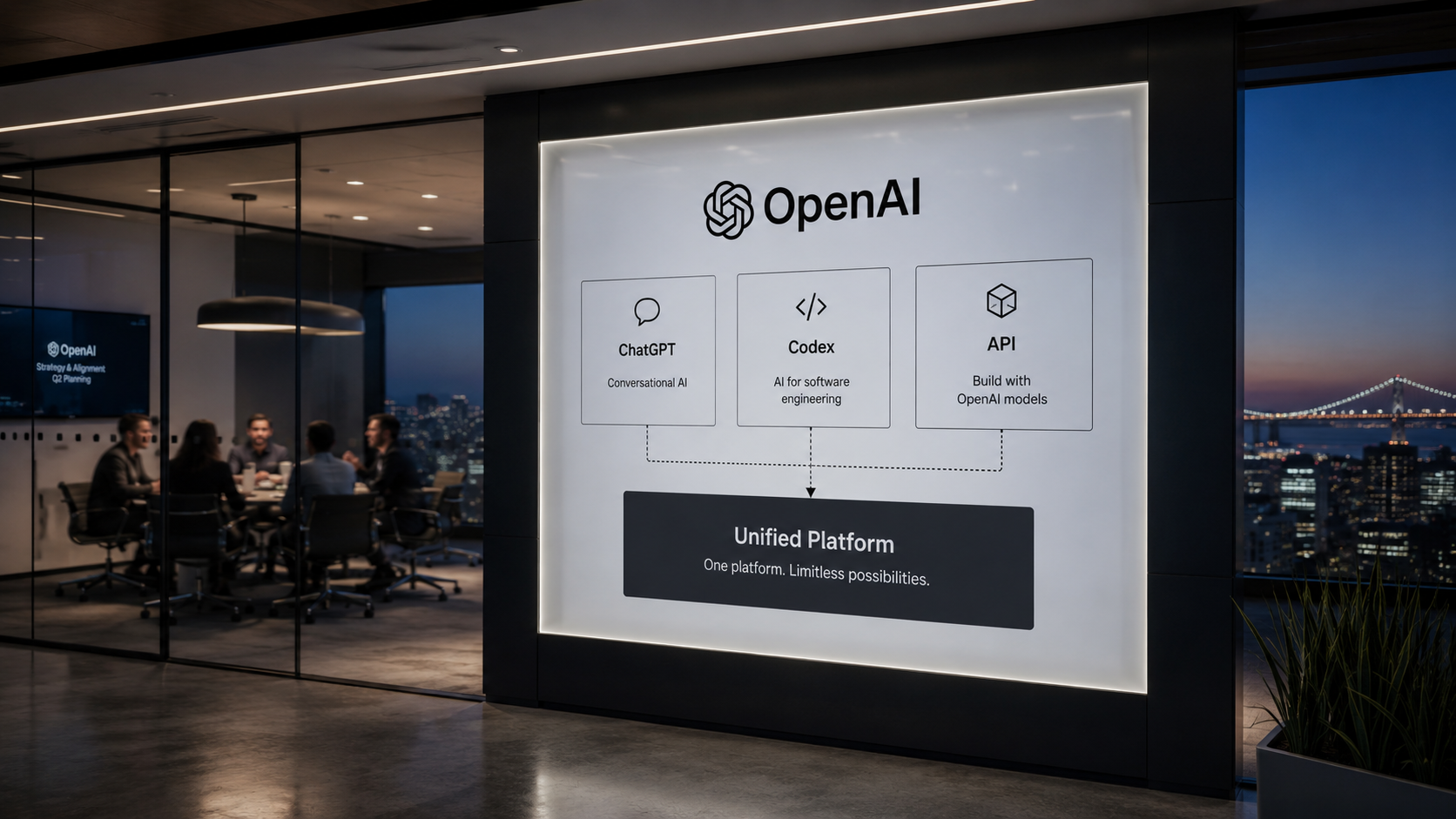
OpenAI has told employees it is collapsing ChatGPT, its Codex AI coding agent, and its developer-facing API into a single product organization — a structural overhaul that puts Greg Brockman permanently in charge of all product strategy and positions the company for a possible IPO later this year.
The announcement, confirmed to WIRED from an internal memo and also reported by The Verge, came on Friday May 15. Brockman wrote that OpenAI would "invest in a single agentic platform and merge ChatGPT and Codex into one unified agentic experience for all."
Three Products, One Team
Until now, ChatGPT, Codex, and the developer API operated under separate leadership with their own roadmaps. ChatGPT pursued consumer reach; Codex served developers building AI-assisted coding workflows; the API monetized the broader ecosystem. Collapsing all three under one team is a structural admission that the previous arrangement had become unwieldy at OpenAI's current scale.
Thibault Sottiaux — the engineer who built Codex into one of OpenAI's fastest-growing products — now leads the combined core product and platform across consumer, enterprise, and developer surfaces. Nick Turley, who grew ChatGPT to 900 million weekly active users, moves to a new role focused on enterprise products. Brockman's argument is straightforward: "A ChatGPT that cannot write and run code is a chat interface, and a Codex product without a consumer-facing layer is a tool that only engineers can access."
The Super App Already in Development
The reorg accelerates a project that became public in March, when the Wall Street Journal reported OpenAI was building a desktop super app combining ChatGPT, Codex, and its Atlas browser into a single application. OpenAI confirmed the effort. Sottiaux told reporters the company was "building the super app out in the open."
The app is designed around agentic behavior: a built-in browser, a code-execution layer, and a conversational interface that can complete multi-step digital tasks — scheduling, research, code deployment, document drafting — without context-switching between tools. The rollout will be gradual: Codex expands first to productivity tasks beyond coding, then ChatGPT and Atlas fold in. No launch date has been announced.
What It Means for Codex Developers
For developers currently building on the Codex platform, the announcement creates genuine uncertainty. OpenAI has not specified what the product integration means for existing Codex API customers or published an integration timeline. The company has a track record of collapsing products and endpoints — the Assistants API deprecation, the GPT-4o API retirement, the Sora shutdown — without extended transition periods. Developers with Codex integrations currently have no public guarantee of API continuity.
The mobile ChatGPT application remains a separate product for now. The reorg explicitly targets the desktop experience and a unified agentic workflow.
The IPO Case and Competitive Pressure
The timing is not subtle. OpenAI is targeting a public listing as early as Q4 2026, with an $852 billion post-money valuation from its most recent funding round. A prospectus describing three product teams competing for compute invites analyst discounts; a single agentic platform with 900 million weekly users does not.
Competition drove the restructuring forward. Anthropic's Claude Code has been gaining significant ground with developers, and Google's Gemini grew its share of AI web traffic from 5.7% to 21.5% over the past year while ChatGPT's share declined from 86.7% to 64.5%, according to Similarweb data cited by CMC Markets. Google I/O 2026 opens May 19 with agentic coding and Gemini model updates headlining — the same territory this reorg is designed to defend.
The announcement also arrives after a month of significant executive departures. On April 17, OpenAI lost three senior leaders in a single day: Kevin Weil (AI workspace), Bill Peebles (Sora), and Srinivas Narayanan (enterprise applications CTO). Fidji Simo, OpenAI's CEO of Applications, remains on medical leave — the vacancy that put Brockman in the interim product role now made permanent.
What Is Unconfirmed
OpenAI has not published an integration roadmap for the ChatGPT-Codex merge. API continuity terms for existing Codex customers remain unaddressed. Rate limits, pricing, and SDK compatibility implications have not been announced. The company's CFO Sarah Friar has warned internally that a 2026 IPO timeline may slip if infrastructure costs continue outpacing revenue growth — OpenAI projects $14 billion in losses on roughly $25 billion in annualized revenue, with profitability not expected before 2029.