Vercel Labs Ships Zero: A Programming Language Built for AI Agents
Vercel Labs has open-sourced Zero, an experimental systems language with JSON diagnostics and typed repair metadata — the first language designed from the ground up for AI coding agent workflows.
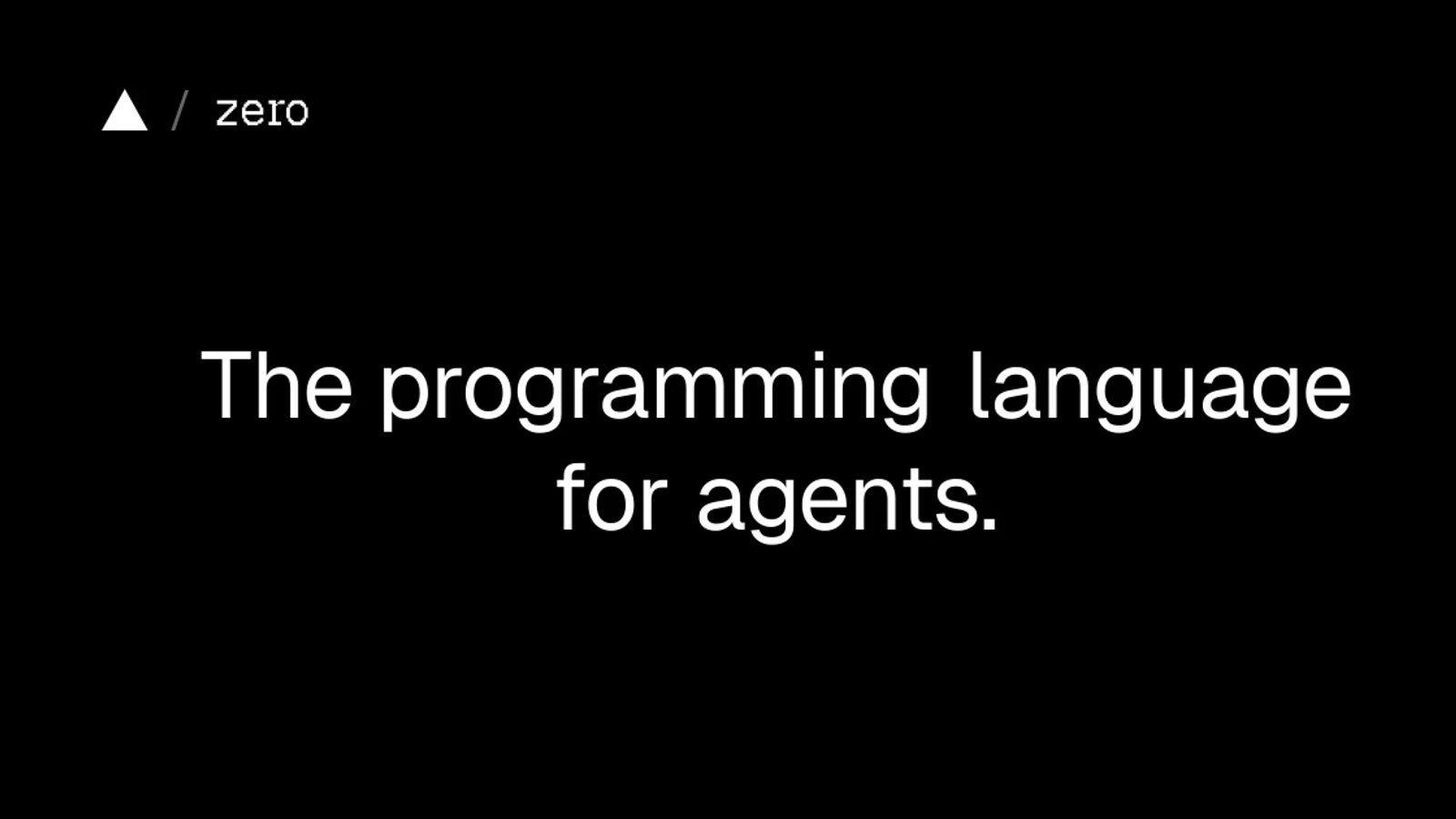
Image source: Open Graph image
AI Agents, News & Updates
Vercel Labs Ships Zero: The First Programming Language Designed from the Ground Up for AI Coding Agents
Vercel Labs has released Zero, an experimental systems programming language that replaces human-readable compiler output with structured, machine-parseable diagnostics — built specifically so AI coding agents can read, repair, and ship native programs without human translation.
May 17, 2026 · 3 min read
Image by Vercel Labs
Vercel Labs Ships Zero: The First Programming Language Designed from the Ground Up for AI Coding Agents#vercel-labs-zero-language-for-ai-agents
Today, Vercel Labs — the experimental research arm of Vercel — published Zero to GitHub under the Apache-2.0 license. The language, built by Vercel Labs engineers Chris Tate and Matt Van Horn, targets the same systems programming space as C and Rust, but with a fundamentally different design goal: the compiler's output is written for AI agents, not human engineers.
The release arrives as coding agents — Claude Code, Cursor, OpenAI Codex — are rapidly shifting from interactive assistants into autonomous infrastructure that runs in CI/CD pipelines, handles background tasks, and opens pull requests without a human in the loop. The problem those agents consistently hit is compiler feedback. Standard compilers emit error messages written as prose, forcing agents into a fragile loop of text parsing that breaks whenever message formats change between compiler versions.
Zero eliminates that loop at the language level.
Agent-Native Compiler Output
The core design decision in Zero is that its CLI emits JSON diagnostics by default. When an agent runs zero check --json, the output is a structured object:
json1{ 2 "ok": false, 3 "diagnostics": [{ 4 "code": "NAM003", 5 "message": "unknown identifier", 6 "line": 3, 7 "repair": { "id": "declare-missing-symbol" } 8 }] 9}
Each diagnostic carries a stable code that agents can match programmatically, a human-readable message, a line reference, and a typed repair object. "Humans read the message. Agents read the code and repair," according to the project documentation. Both are served from a single CLI command — there is no separate agent-mode tool to invoke.
Two subcommands complete the repair loop. zero explain <diagnostic-code> returns a structured explanation of any error code, giving agents direct lookup without scraping documentation. zero fix --plan --json <file> emits a machine-readable fix plan — a description of what changes to make to resolve a diagnostic — rather than requiring the agent to infer a fix from prose.
A third subcommand, zero skills get zero --full, serves version-matched agent guidance directly from the CLI: syntax, diagnostics, builds, packages, standard library usage, and agent edit loops, all matched to the installed compiler version. This avoids the common failure mode where documentation served externally drifts out of sync with the actual compiler in use.
Explicit Effects and Predictable Memory
Beyond diagnostics, Zero makes language-level design choices that benefit agentic workflows. Effects — filesystem access, network calls, standard I/O — must be explicitly declared in function signatures via a capability object:
textpub fun main(world: World) -> Void raises { check world.out.write("hello from zero\n") }
A function that does not receive World cannot perform I/O. The compiler enforces this at compile time, not at runtime. There is no hidden global process object, no implicit async, and no magic globals. The result is that memory and control flow are fully visible in signatures, making agent-generated code substantially easier to audit and repair.
Zero also targets sub-10 KiB native executables with no mandatory garbage collector and no mandatory event loop. It cross-compiles via targets like linux-musl-x64, and zero size --json reports artifact size before code generation — another structured output designed for agents building and inspecting their own toolchain output.
Agent Skills Integration
Vercel Labs connected Zero's toolchain to the Agent Skills ecosystem it launched in January 2026 — described at the time as an "npm for AI agents" — with integrations across Claude Code, Cursor, and OpenAI Codex. Zero's zero skills command extends that ecosystem directly into the language's native toolchain, so agents using Zero inherit the same skills distribution model that already has over 200 published skill packs.
For teams that have embedded Cursor, Claude Code, or Codex into their CI/CD pipelines, Zero's design directly addresses the friction those pipelines encounter when the agent needs to build or modify low-level native tooling: the compiler becomes a peer that speaks structured data rather than a black box that speaks error prose.
What Is and Is Not Production-Ready
Zero v0.1.1 is explicitly experimental. The compiler, standard library, docs, and language specification are not stable. There is no package registry yet, and cross-compilation is limited to a documented target subset. A VS Code extension for .0 file syntax highlighting ships in the repository under extensions/vscode/, but it is minimal. The project's own README makes the experimental status explicit: "the language is not stable yet."
Vercel Labs has not announced production timelines, integration plans with the main Vercel platform, or any path to general availability. Whether Zero becomes a serious part of the agentic developer toolchain or remains a research experiment depends on whether the core thesis — that agent-first compiler output materially improves autonomous coding workflows — holds up under real workload testing.
What is clear today is that Vercel Labs is making a direct bet that the toolchain layer, not just the model layer, needs to be rebuilt for agentic development. Zero is the first production-candidate attempt at a programming language where the agent, not the human, is treated as the primary consumer of compiler feedback.
The repository is live at github.com/vercel-labs/zero. Documentation and the installer are at zerolang.ai.