Google Launches Gemini 3.5 Flash and Antigravity 2.0 at I/O
Google unveiled Gemini 3.5 Flash and Antigravity 2.0 at I/O 2026 — a 4x-faster agentic model and a new agent-first coding IDE that puts Google in direct competition with Claude Code and OpenAI Codex.

title: "Google Launches Gemini 3.5 Flash and Antigravity 2.0 at I/O" slug: "google-io-2026-gemini-35-flash-antigravity" date: "2026-05-20" description: "Google unveiled Gemini 3.5 Flash and Antigravity 2.0 at I/O 2026 — a 4x-faster agentic model and a new agent-first coding IDE that puts Google in direct competition with Claude Code and OpenAI Codex."
AI Agents, News & Updates
Google Launches Gemini 3.5 Flash and Antigravity 2.0 at I/O
Google's new model outperforms Gemini 3.1 Pro across all coding and agent benchmarks, while Antigravity 2.0 ships as a standalone desktop IDE powered by multi-agent orchestration — available globally today.
May 20, 2026·3 min read
Image by Google
Google Launches Gemini 3.5 Flash and Antigravity 2.0 at I/O
Google kicked off I/O 2026 with its most developer-focused release slate in years: Gemini 3.5 Flash, a new frontier model built specifically for agentic and coding workloads, went generally available today alongside Antigravity 2.0, a standalone desktop application that positions Google squarely against Claude Code and OpenAI Codex.
The dual launch signals Google's strategic pivot from AI assistants to autonomous agents. Where earlier Gemini releases competed on reasoning benchmarks, 3.5 Flash was co-developed with Antigravity so the model and the platform could evolve together — a tighter integration than what either Anthropic or OpenAI currently ships as a matched pair.
"3.5 Flash offers an incredible combination of quality and low latency. It outperforms our latest frontier model, 3.1 Pro, on nearly all the benchmarks," including coding, agentic tasks, and multimodal reasoning, DeepMind Chief Technologist Koray Kavukcuoglu told reporters ahead of the launch.
Gemini 3.5 Flash: The Numbers
Gemini 3.5 Flash is available immediately via the Gemini API, Google AI Studio, and Antigravity. The model ships with a 1 million token context window, 65K max output tokens, and a speed advantage Google describes as 4x faster than competing frontier models — rising to 12x faster inside Antigravity due to platform-level token optimization.
On Terminal-Bench 2.1, a benchmark for agentic performance in real terminal environments, 3.5 Flash scores 76.2% and outperforms Gemini 3.1 Pro across coding and agent task categories. Pricing is $1.50 per million input tokens and $9.00 per million output tokens, with a 90% discount on cached input — a structure Google is positioning as the economics tier for long-running multi-agent workloads. For context, Claude Sonnet 4.6 is priced at $3/$15 per million tokens.
Google also noted that it now processes more than 3.2 quadrillion tokens per month, up 7x year-over-year from 480 trillion per month at I/O 2025 — the scale backdrop explaining why Google built a faster, cheaper model rather than a higher-capability one for this release.
Antigravity 2.0: Google's Answer to Claude Code
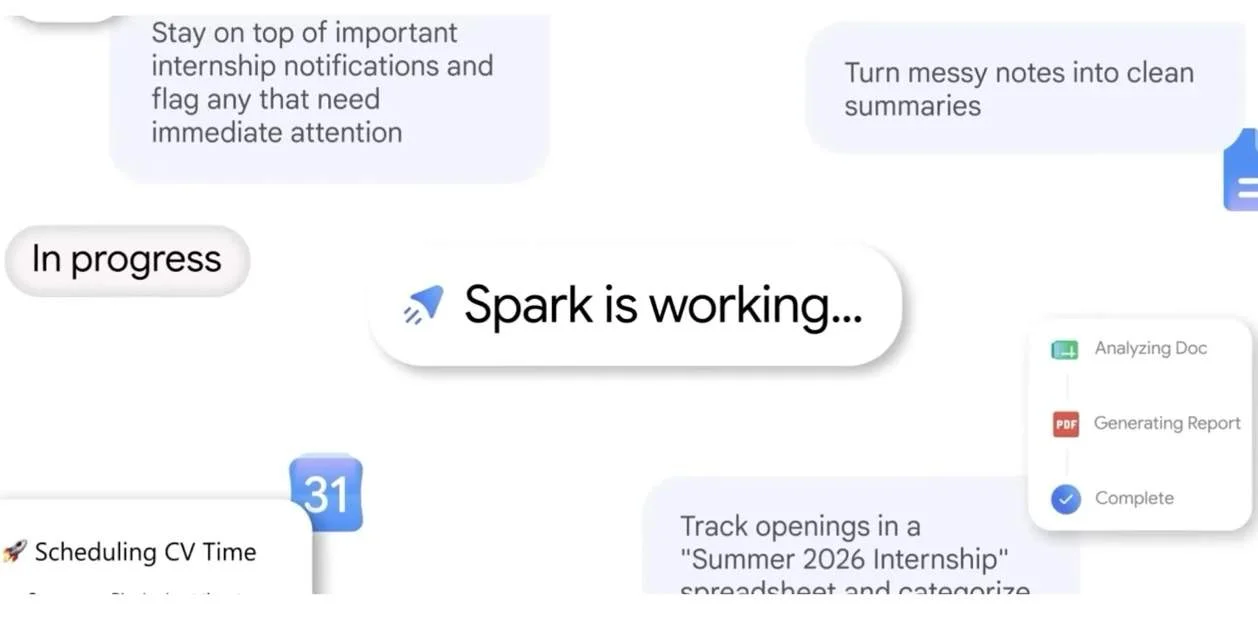
Antigravity 2.0 ships today as a globally available standalone desktop application. It is Google's direct equivalent of Claude Code and OpenAI Codex. The application comes with two primary surfaces: an Editor view that functions as a familiar IDE interface with an agent sidebar, and a Manager view designed to orchestrate multiple agents running in parallel across workspaces.
At the I/O keynote, Google engineer Varun Mohan demonstrated Antigravity agents spawning off to work on separate components of a project before reassembling to build a functioning operating system from scratch in 12 hours. The orchestration pattern mirrors what Anthropic's Managed Agents and OpenAI's parallel Codex workflows target, but Google ships it as a matched model-platform pair from day one.
Alongside the desktop app, Google shipped an Antigravity CLI for terminal-first workflows and an Antigravity SDK that allows developers to programmatically control the agent harness and deploy it on their own infrastructure — a self-hosting option that neither Anthropic nor OpenAI currently offers for their equivalent agentic coding tools.
Managed Agents and the New $100 AI Ultra Plan
For developers who want agent infrastructure without running Antigravity locally, Google announced Managed Agents in the Gemini API. A single API call provisions a fully operational agent — with reasoning, tool use, and code execution — in an isolated Linux sandbox. The harness is identical to the one powering Antigravity, which means Managed Agents and the desktop IDE share the same underlying execution model.
Google also introduced a $100 per month Google AI Ultra plan at I/O, providing 5x higher Antigravity usage limits than the existing Pro plan. A time-limited launch offer gives new and existing Ultra subscribers $100 in bonus Antigravity credits, expiring May 25.
What It Means for Developers
Google's agent stack at I/O 2026 arrives with real breadth: a model benchmarked on terminal and coding tasks, a free-to-download desktop IDE available today, API-level managed agent infrastructure, and a CLI and SDK for teams that prefer custom deployment. The completeness is notable.
Until now, Anthropic held the tightest end-to-end story for agentic coding through Claude Code, and OpenAI's Codex ecosystem has been building breadth through its mobile and desktop rollouts. Google is now in the race with a full stack rather than point tools.
The friction points worth tracking: Antigravity's developer ecosystem is younger than Cursor's or Windsurf's, and developer commentary at I/O flagged naming confusion between the Gemini CLI and the Antigravity CLI as an early rough edge. There is also a pricing note: at $9.00 per million output tokens, 3.5 Flash is priced closer to mid-tier frontier models than cheap inference, which matters for teams running high-volume agent loops.
For developers ready to evaluate: Antigravity 2.0 is available at antigravity.google. The Gemini API with Managed Agents and Gemini 3.5 Flash is live at ai.google.dev. The Antigravity SDK documentation is at the Google developer portal.