RevenueCat
In-app subscription and purchase management platform for iOS, Android, and web apps, handling billing, customer data, and revenue growth tools.
Key Features
- ✓Cross-platform in-app purchase implementation (iOS, Android, web, Smart TV)
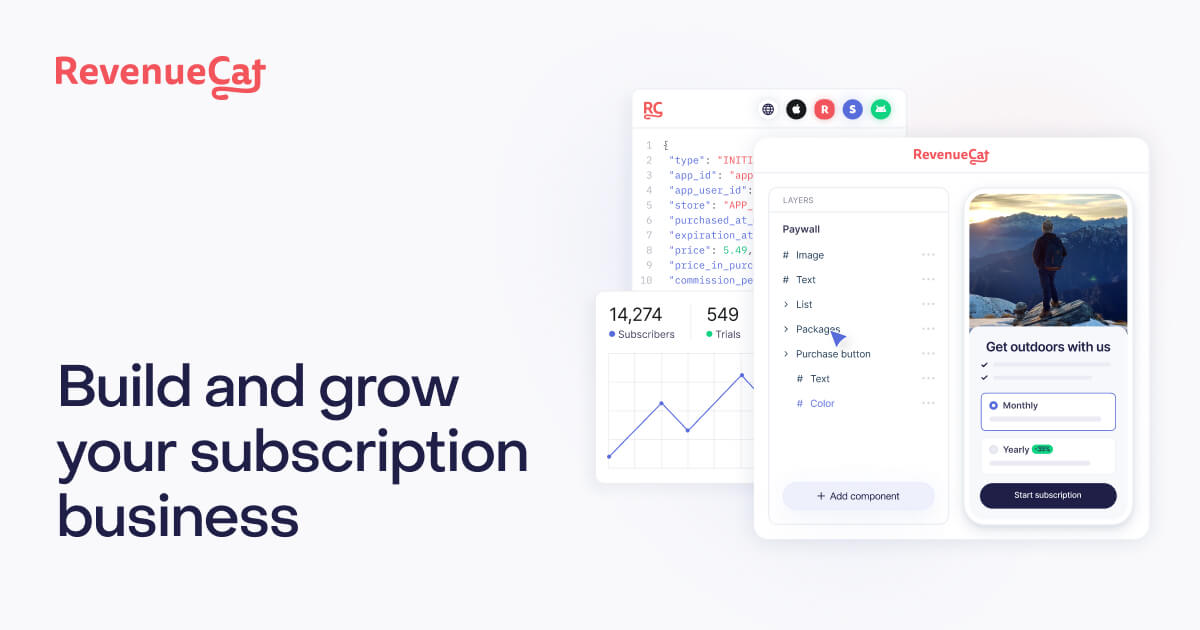
- ✓Paywall builder with pre-built templates and A/B testing
- ✓Customer subscription management and analytics
- ✓Automated refund handling
- ✓Revenue and campaign performance tracking
- ✓SDK with simplified purchase APIs
RevenueCat
If you've ever tried to implement in-app subscriptions from scratch, you know the pain. Apple's StoreKit, Google Play Billing, Stripe for web, Amazon IAP on Fire TV -- each platform has its own receipt validation, edge cases, and server-side logic to get right. RevenueCat is a backend-as-a-service platform specifically for in-app purchases and subscriptions that abstracts away all of that fragmentation and gives you a single, normalized layer to work with.
The core idea is simple: you get a wrapper around StoreKit, Google Play Billing, and web-based payments that makes it straightforward to manage in-app purchases and centralize subscriber data. Rather than maintaining your own receipt-validation server and wiring up webhooks from four different stores, you drop in the RevenueCat SDK and delegate all of that to their infrastructure.
Who It Is For
RevenueCat is built squarely for mobile app developers -- solo indie developers, small teams, and larger studios all use it. Setting it up takes minutes, and it cuts out months of potential headache dealing with the different scenarios you need to handle in-app purchases: buying, renewing, pausing, canceling, and so on. It also works for cross-platform projects. RevenueCat offers SDKs for iOS, Android, Flutter, React Native, Cordova, Unity, and macOS , which means you are not locked into a single framework or stack.
It is less of a fit for pure web SaaS products where Stripe Billing alone would suffice, but if you are shipping anything on the App Store or Google Play that needs subscriptions, RevenueCat is the de facto starting point most developers reach for.
Pricing
RevenueCat is free until you reach $2,500 in Monthly Tracked Revenue (MTR). MTR is calculated on gross revenue before the platform cut, which is worth understanding before you budget. Beyond the free tier, pricing is usage-based:
| Plan | Free Threshold | Rate Above Threshold |
|---|---|---|
| Free / Pro | Up to $2,500 MTR/mo | 1% of MTR |
| Enterprise | Custom | Custom (negotiated) |
No charges apply in months where you do not hit the $2,500 threshold , so early-stage apps pay nothing. For new apps or those earning less than $2,500 per month, the free plan gives you access to all the core functionality needed to launch and manage in-app purchases. Once you scale, 1% of gross revenue is a real cost to factor in, and some developers express discomfort handing over that percentage as revenue grows. That said, the alternative -- building and maintaining this infrastructure yourself -- is not free either.
Strengths
The main reason developers stick with RevenueCat is that it genuinely works and saves time. RevenueCat handles most of the subscription management behind the scenes, which saves a significant amount of development time. The dashboard gives you subscriber analytics, charts, and cohort data across all platforms in one place -- something you would otherwise have to stitch together yourself from App Store Connect and the Google Play Console.
The paywall builder and A/B testing tooling (called Experiments) are also useful for teams that want to test pricing and offer configurations without shipping a new app version. The RevenueCat and Braze integration allowed at least one team to implement fast winback and upgrade messaging that resulted in a membership churn reduction of almost 5%.
On the reliability side, RevenueCat claims 99.99% uptime and processes billions of receipts daily.
Limitations
The percentage-of-revenue pricing model is the most common friction point. As your app scales, the fee compounds, and at that stage some teams start evaluating whether to internalize the infrastructure. Competitors like Adapty position themselves as the more growth-focused alternative, while RevenueCat focuses more on subscription infrastructure basics .
Latency on propagating product changes from the App Store to the RevenueCat dashboard has also been noted by developers. After creating products in App Store Connect, there can be a wait of a few hours before they show up in RevenueCat , which is more of an Apple constraint than a RevenueCat bug, but it does affect the development workflow.
Bottom Line
RevenueCat is the easiest path to production-ready in-app subscriptions for most mobile developers. The free tier is genuinely useful, the SDKs are well-maintained, and the documentation is solid. If you are early-stage, there is almost no reason not to use it. If you are already generating significant revenue, run the numbers on the 1% fee and decide whether the time saved on maintenance is still worth the trade. For most teams, it is.